Actor-Network Theory:
Bruno Latour’s Actor Network Theory (ANT) is a sociological theory that views society as made up of networks of both human and non-human actors (also known as “actants”). Latour states, “ANT aims at accounting for the very essence of societies and natures. It does not wish to add social networks to social theory but to rebuild social theory out of networks. It is as much an ontology or a metaphysics, as a sociology.”
These networks are sometimes described as socio-technical systems, but they can encompass more than just people and technology. ANT prescribes agency to actants based on their ability to affect the course of events within a network. Thus, the agency is not an inherent property of any actant, but rather it is realized through the actant’s relationships within a network.
To say something has agency here means simply to acknowledge its ability to influence the network through its relationships with other actants in the network. Nobody is saying your bank account can make its own choices; rather, the agency of your bank account is born out through its effects on the choices you make.
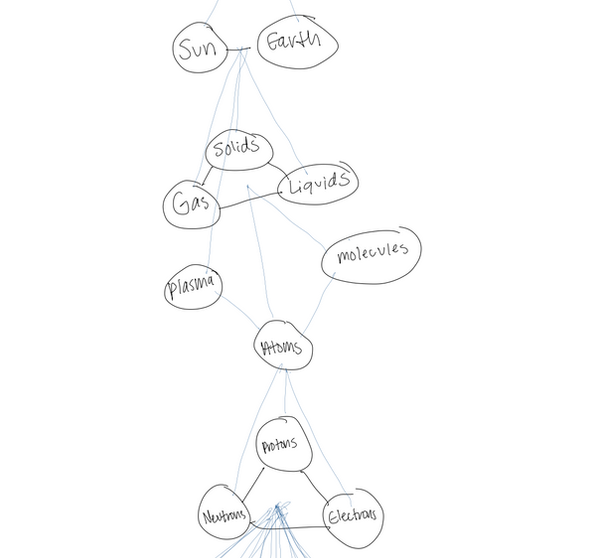
ANT Maps allow you to connect people, institutions, concepts, and inanimate objects together, showing how everything is interconnected. You can create a node that is one actant or a network of actants that you can zoom in on. The point of creating the skeleton of our society’s web (I say skeleton because it would be impossible to create an extensive map of our entire U.S. society in one semester) is to show that fixing the problems in today’s world requires much more than just taking out “one bad guy” or “a few faulty institutions.” A web doesn’t have a heart. It has to be torn down in multiple places for it to fall apart.
My skeleton map:


References
Alberts, B., Johnson, A., Lewis, J., Morgan, D., Raff, M., Roberts, K., & Walter, P. (2015). Molecular biology of the cell (6th ed.). Garland Science.
Atkins, P., & de Paula, J. (2014). Physical chemistry (10th ed.). Oxford University Press.
Axelrod, R. (1984). The evolution of cooperation. Basic Books.
Baum, D. (2016, April). Legalize it all. Harper’s Magazine.https://harpers.org/archive/2016/04/legalize-it-all/
Burbidge, E. M., Burbidge, G. R., Fowler, W. A., & Hoyle, F. (1957). Synthesis of the elements in stars. Reviews of Modern Physics, 29(4), 547–650. https://doi.org/10.1103/RevModPhys.29.547
Carson, E. A. (2020). Prisoners in 2019. Bureau of Justice Statistics. https://bjs.ojp.gov
Center for Responsive Politics. (2021). Outside spending in federal elections. https://www.opensecrets.org
Çengel, Y. A., & Boles, M. A. (2015). Thermodynamics: An engineering approach (8th ed.). McGraw-Hill Education.
Citizens United v. Federal Election Commission, 558 U.S. 310 (2010).
Commission to Study and Develop Reparation Proposals for African Americans Act, H.R. 40, 117th Cong. (2021).
Community Reinvestment Act, 12 U.S.C. § 2901 (1977).
Congressional Budget Office. (2021). The effects of a $15 minimum wage by 2025. https://www.cbo.gov
Darwin, C. (1859). On the origin of species. John Murray.
DISCLOSE Act of 2021, H.R. 1, 117th Cong. (2021).
Einstein, A. (1916). Relativity: The special and general theory. Henry Holt and Company.
European Union. (2016). General Data Protection Regulation (EU) 2016/679.
Fair Sentencing Act of 2010, Pub. L. No. 111-220.FairVote. (2021). Ranked choice voting in practice. https://fairvote.org
Federal Reserve. (2020). Survey of consumer finances. https://www.federalreserve.gov
Freeman, R. B. (2004). What do unions do? Industrial and Labor Relations Review, 38(2), 244–263.
Gilens, M., & Page, B. I. (2014). Testing theories of American politics: Elites, interest groups, and average citizens. Perspectives on Politics, 12(3), 564–581. https://doi.org/10.1017/S1537592714001595
Griffiths, D. J. (2017). Introduction to elementary particles (2nd ed.). Wiley-VCH.
Griffiths, D. J. (2018). Introduction to quantum mechanics (3rd ed.). Cambridge University Press.
Hu, E. (2013, August 20). Facebook Makes Us Sadder and Less Satisfied, Study Finds. NPR.https://www.npr.org/sections/alltechconsidered/2013/08/19/213568763/researchers-facebook-makes-us-sadder-and-less-satisfied
Hu, E. (2014, June 30). Facebook Manipulates our Moods for Science and Commerce: Aroundup. NPR.https://www.npr.org/sections/alltechconsidered/2014/06/30/326929138/facebook-manipulates-our-moods-for-science-and-commerce-a-roundup
Kasting, J. F., Whitmire, D. P., & Reynolds, R. T. (1993). Habitable zones around main sequence stars. Icarus, 101(1), 108–128. https://doi.org/10.1006/icar.1993.1010
Latour, B. (2005). Reassembling the Social: An Introduction to Actor-Network-Theory. New York: Oxford University Press.
Miller, E. K., & Cohen, J. D. (2001). An integrative theory of prefrontal cortex function. Annual Review of Neuroscience, 24, 167–202. https://doi.org/10.1146/annurev.neuro.24.1.167
Mozur, P. (2018, October 15). A genocide incited on Facebook. The New York Times.
Planck Collaboration. (2020). Planck 2018 results. VI. Cosmological parameters. Astronomy & Astrophysics, 641, A6. https://doi.org/10.1051/0004-6361/201833910
Rosenberg, K., & Trevathan, W. (2002). Birth, obstetrics, and human evolution. BJOG: An International Journal of Obstetrics & Gynaecology, 109(11), 1199–1206. https://doi.org/10.1046/j.1471-0528.2002.01369.x
Schwartz, M. D. (2014). Quantum field theory and the standard model. Cambridge University Press.
Smith, A. (1776). An inquiry into the nature and causes of the wealth of nations. W. Strahan & T. Cadell.
Szostak, J. W. (2012). The eightfold path to non-enzymatic RNA replication. Journal of Systems Chemistry, 3(2). https://doi.org/10.1186/1759-2208-3-2
The Sentencing Project. (2021). Report to the United Nations on racial disparities in the U.S. criminal justice system. https://www.sentencingproject.org
Tomasello, M. (1999). The cultural origins of human cognition. Harvard University Press.
United Nations Human Rights Council. (2018). Report of the independent international fact-finding mission on Myanmar (A/HRC/39/64). https://www.ohchr.org
U.S. Const. amend. XIII.
United States Sentencing Commission. (2011). Report to Congress: Cocaine and federal sentencing policy.
Wise, T. A. (2010). Agricultural dumping under NAFTA. Tufts University Global Development and Environment Institute.
Zuboff, S. (2019). The age of surveillance capitalism. PublicAffairs.